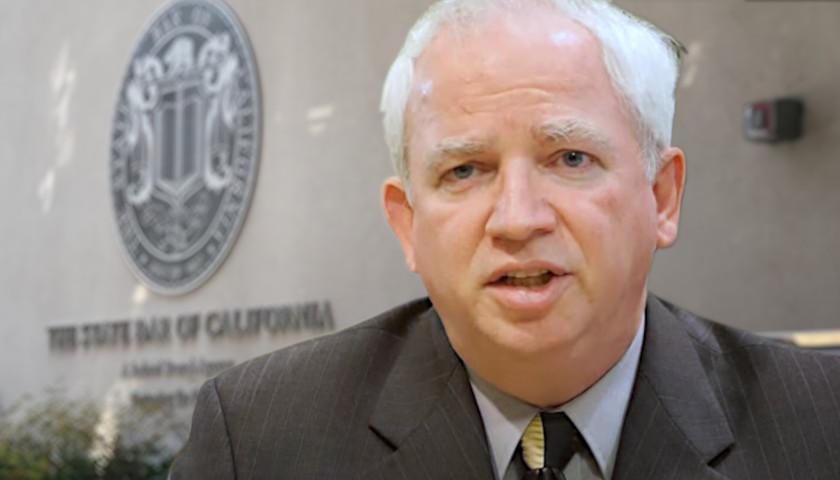
The California Supreme Court on Wednesday issued a final order disbarring prominent constitutional scholar and former Trump attorney John C. Eastman (State Bar No. 193726), ending the latest phase of a years-long disciplinary proceeding tied to his legal advice regarding the 2020 presidential election. In a terse docket entry, the court denied Eastman’s petitions for review and ordered his name stricken from the roll of attorneys. The court also imposed a $5,000 monetary sanction payable to the State Bar of California Client Security Fund, awarded costs to the State Bar, and required Eastman to comply with California Rules of Court, rule 9.20, within specified deadlines.
“‘Denied; disbarred,'” Eastman posted on social media Thursday morning.
“With that cursory ruling, the Cal. S.Ct declined to take my case despite clear First Amendment violations. So Bar Court disbarment recommendation now takes effect. We will appeal to U.S. S.Ct. Costly, but important,” he added.
Eastman told The Daily Journal that the disbarment was “quite disappointing and even more outrageous,” labeling it the “death penalty” for his legal career.
His attorney, Randall A. Miller, issued a statement to media confirming the long-time Trump ally will file a petition for review with the U.S. Supreme Court “in very short order” to “repudiate this threat to the rule of law and our nation’s adversarial system of justice.” Miller argued that the California ruling “departs from long-standing United States Supreme Court precedent protecting First Amendment rights, especially in the attorney discipline context” and raises “pivotal constitutional concerns regarding the limits of state regulation of attorney speech.”
Eastman is among dozens of legal professionals to face efforts to strip them of the ability to practice law. Rudy Giuliani was disbarred by both the D.C. Bar and New York bar authorities. Trump campaign attorney Jenna Ellis agreed to a three-year suspension of her Colorado law license. Kenneth Chesebro, another architect of Trump’s bid to remain in power, lost his New York law license.
Jeffrey Clark, who is facing his own disbarment proceeding in Washington, called Eastman’s disbarment “a travesty” in a social media statement, insisting Eastman “lied about nothing” and urging the U.S. Supreme Court to take up the case.
The disbarment comes despite a presidential pardon Trump issued in November 2025, which covered Eastman and dozens of others accused of trying to overturn the 2020 election. Georgia prosecutors had already dropped their RICO case against Eastman after Trump won the 2024 election.
Meanwhile, State Bar Chief Trial Counsel George Cardona issued a statement hailing the decision.
“Today’s California Supreme Court order disbarring John Charles Eastman from the practice of law in California affirms the fundamental principle that attorneys must act with honesty and uphold the rule of law, regardless of the client they represent or the context in which that representation occurs.”
The decision follows the State Bar Court’s Hearing Department recommendation in March 2024 — affirmed by the Review Department in June/July 2025 — that Eastman be disbarred after being found culpable on 10 of 11 counts of “misconduct.” Those counts stem from Eastman’s role in advising President Donald Trump on potential legal challenges to the 2020 election results, including the drafting of memoranda outlining options for Vice President Mike Pence to address disputed electoral votes and the use of alternate slates of electors in contested states.
Eastman, a former dean of Chapman University’s Fowler School of Law and a recognized expert in constitutional law, maintained throughout the proceedings that his work involved legitimate legal analysis of unresolved questions under the Electoral Count Act and Article II of the U.S. Constitution — issues that had never been squarely resolved by the courts.
He argued that Vice President Pence, in his role presiding over the joint session of Congress, possessed authority to resolve disputes over competing electoral slates from states where allegations of irregularities, including statistical anomalies, ballot stuffing, absentee ballot mishandling, observer exclusions, and voting machine issues were widespread.
In his defense filings and public statements, Eastman repeatedly emphasized that these were “novel and unresolved” constitutional questions, describing the vice president’s authority as a “non-justiciable political question.” He noted that no court had ever sanctioned his filings or positions as frivolous, and even the State Bar’s prosecutors acknowledged the issues were novel. Eastman contended that the disciplinary action punished him for protected “professional speech” and zealous client advocacy, violating his First Amendment rights.
He accused the proceedings of selective enforcement, bias (citing the hearing judge’s political donations and disparate treatment of evidence and witnesses), and Orwellian logic, demanding acceptance of the government’s narrative on the 2020 election regardless of evidence of irregularities.
Eastman’s opening brief in the State Bar Court appeal described the prosecution as “a manifestation of George Orwell’s dystopic depiction of authoritarianism — statements by the Government, no matter how demonstrably false or suspect, must be accepted as truth.” He argued that evidence of election irregularities was systematically excluded or downplayed, while the Bar’s case relied on post-election developments and hearsay.
“Every attorney, regardless of side, politics, or personal or legal beliefs, should shudder at the notion that they, too, or any of their brethren, can be the subject of the same convenient, trendy, and selective interrogation,” he warned.
The State Bar, however, maintained that Eastman advanced false claims, misled courts and officials, and engaged in moral turpitude by promoting a “false narrative” about the election to subvert its results.
– – –
Christina Botteri is the Executive Editor of The Tennessee Star and The Star News Network. Follow her on X at @christinakb.
Image “John Eastman” by John Eastman and “California Bar Association” by Rachel Alexander.